
Yamaha has released its much awaited fifth-generation R1 incorporating a whole range of trick new technology to enhance the man-machine relationship.2007 YZF-R1 is developed using new technologies to produce the most linear, controllable power ever.
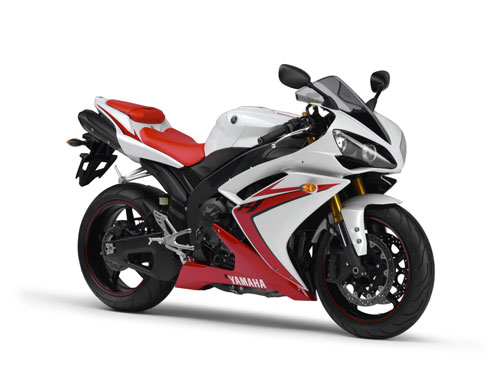
Featuring an all-new engine, chassis and bodywork, the new R1 can justifiably claim to be the most sophisticated high-tech supersport machine ever built. And it also delivers the most exciting, rewarding and responsive riding experience imaginable.
The new superbike is fitted with YCC-T (Yamaha Chip Controlled Throttle) which has played a pivotal role in making the new-generation YZF-R6, today’s leading 600 supersport machine.
And for 2007, Yamaha introduces YCC-I (Yamaha Chip Controlled Intake), the latest ground-breaking innovation in electronic intake control designed to raise the performance of the new R1 to a new level.
Yamaha Race Team’s Jamie Stauffer dominated the YMF Loan Australian Superbike Championship on last year’s YZF-R1SP. This year he is looking forward to the increased performance of the new model which delivers 180bhp at 12,500rpm (189bhp including direct air induction).
But it’s the controllable character of the power delivery that marks this machine out as a leader. This well-rounded supersport machine delivers a broad spread of linear power throughout a wider rpm range compared to the previous model, making the 2007 R1 an even more impressive performer on both the road and track.
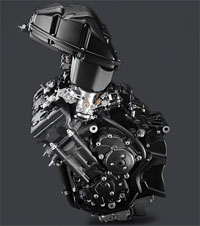 The new fifth-generation R1 is powered by the most powerful and the most technologically-advanced engine ever featured on a production Yamaha. Its liquid-cooled 4-stroke in-line four-cylinder engine runs with the same bore x stroke dimensions of 77 x 53.6mm as the 2006 model, but that is where the similarity ends. Peak power has been increased by 5bhp over 2006 model, and the transitional characteristics of the power are dramatically improved on the new machine.
YCC-I makes its debut on the 2007 YZF-R1, and is the first-ever electronically-controlled motor-driven variable intake on a production motorcycle.
The intake passage length on an engine is designed to ensure the highest volumetric efficiency in the most commonly used rpm band for that particular powerplant. Generally speaking, a long intake
passage and funnel tends to deliver stronger low to mid-range performance, and conversely a shorter intake passage and funnel is typically better for high rpm applications.
Yamaha’s designers have succeeded in creating a unique new electronically-controlled intake system which ensures optimum performance at both low and high engine speeds.
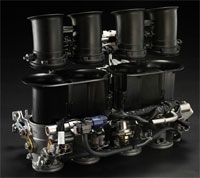 Air induction funnels move from 140mm to 65mm to fine tune power delivery depending on engine revs. The new R1 engine is able to deliver highly efficient performance in a wide range of riding conditions. Riding around town at lower rpm, the 998cc engine is operating with its long 140mm intakes, which give strong torque and excellent throttle response. And once the rider increases the engine speed and throttle opening on fast highways or when circuit riding, the intake length is instantaneously reduced to 65mm, allowing the engine to reach its full potential.
Another advantage of the new YCC-I system is that its structure is minimal and simple, giving optimal reliability combined with low weight.
For 2007 the all-new R1 is also quipped with Yamaha’s widely-acclaimed YCC-T electronic throttle which, combined with the new YCC-I and advanced fuel injection systems, helps to achieve outstanding torque and instant throttle response, from idle right through to the red line.
The YCC-T system makes for an even simpler structure in the intake passage compared to previous mechanical air-control systems (suction piston/sub-throttle valve) and the YCC-I accentuates the benefits of the system.
The advanced YCC-T technology was used to great effect on Valentino Rossi’s MotoGP Championship-winning Yamaha YZR-M1 race bike, and made its successful production bike debut on the 2006 R6. The system senses various aspects of the R1 rider’s throttle operation, and the ECU instantly adjusts the throttle valve opening to the optimum setting by means of a motor drive.
This ensures smooth, instantaneous and linear operating characteristics in response to the slightest input from the rider.
The result (combined with YCC-I) is a remarkably linear torque curve for increased real-world performance and even higher levels of man-machine harmony.
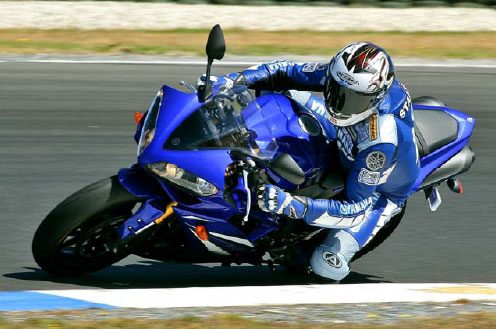
The adoption of control technologies is complemented by the introduction of an all-new cylinder head which is designed to achieve the goal of increased performance at all engine speeds. The R1’s reshaped combustion chamber runs with a higher compression ratio of 12.7:1, and the valve angle has been revised to 24 degrees – the same angle that is used on the 2006 R6.
For 2007 the R1 utilises an all-new four-valve cylinder head design developed from the advanced technology seen on our YZR-M1 MotoGP race bike, and features two 31mm diameter intake valves, and two 25mm exhaust valves. The two intake valves are manufactured from titanium for reduced reciprocating weight, which promotes the increased intake valve lift featured on the 2007 engine. And to ensure efficient high-rpm operation, the R1 runs with lightweight VX alloy valve springs which are designed to handle continuous high-load riding conditions.
These changes to the cylinder head design maximise the benefits of the new YCC-I and YCC-T by ensuring greater air intake volume at all engine speeds. In addition, the revised valve configuration and angle give reduced valve recess compared to the 2006 model, which makes for a smoother piston head shape. The result is extremely high levels of combustion efficiency which contribute greatly to the new engine’s stronger and more linear performance throughout its wide operating range.
The new R1 is designed to deliver the ultimate supersport experience on both the road and circuit, and in order to ensure a smoother approach to the apex of turns, a slipper clutch is fitted. This system shares the same structure as that found on the limited-edition 2006 YZF-R1SP model, and is designed to limit the amount of back-torque transmitted from the rear wheel through to the crank. This race-developed system improves traction during rapid deceleration and hard braking, and enhances engine and transmission reliability.
A completely redesigned exhaust system featuring an optimised length, expansion chamber and pipe sizes (with new-shape mufflers) is fitted. The mufflers’ cross section is an oblate elliptical shape which appears to lift the rear cowl, giving the higher-powered fifth-generation R1 a more aggressive profile. From the rear, the mufflers form a V-configuration to give this remarkable new bike a unique looking tail-end. Spark energy has been increased by a re-evaluation of the coil resistance, and the addition of magnets to the coils helps to reduce magnetic saturation.
A new 3-way catalyser with oxygen sensor not only reduces emissions, it also helps to achieve excellent fuel economy. The new system features platinum and rhodium elements in a honeycomb-shaped catalyser. The system’s efficiency is further improved by the addition of an oxygen sensor which feeds information to the ECU, which can instantaneously adjust fuel supply to ensure optimum combustion efficiency for improved performance and cleaner emissions.
Engine Technical Highlights
• New liquid-cooled 4-stroke in-line 4-cylinder engine
• Bore x stroke 77 x 53.6mm
• Higher 12.7:1 compression ratio
• YCC-I (Yamaha Chip Controlled Intake) variable intake funnel – the first ever electronically-controlled motor-driven system on a production motorcycle
• YCC-T (Yamaha Chip Controlled Throttle) electronic throttle
• 4-valve cylinder head design
• Titanium intake valves
• Redesigned combustion chamber
• Slipper clutch
• Reshaped dual upswept mufflers
• High performance ignition coils
• 3-way catalyser with oxygen sensor
• Closed-deck cylinder
• Liner-less plated cylinder
• FS (Fracture Split) connecting rods
• More efficient Forced Air Intake system
• Compact EXUP with titanium valves
• New-shape twin-fan radiator
The fifth-generation R1 is equipped with an all-new Deltabox frame which has been designed to offer outstanding handling and cornering performance, and strong high-speed stability. Externally this new frame appears similar to the 2006 design, but it is has been completely redesigned, and offers a totally revised rigidity balance which matches the increased performance potential of the new engine.
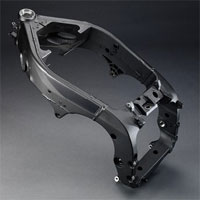 New controlled flex Deltabox chassis is crafted from different types of aluminium to enhance handling qualities and provide excellent rider feedback. For 2007 the cast components that are used for the engine mounts, head pipe and pivot support have been reinforced to give added rigidity at these crucial points. There are six rigid engine mounts (four on the upper and lower crankcase, and two on the cylinder head), and the engine is used as a fully-stressed member.
The outer layer of the Deltabox frame is constructed using 2.5mm thick aluminium panel material to give a certain level of ‘forgiveness’ in the new frame, which enhances handling and cornering performance, and improves surface feedback. Other changes to the new 2007 frame include the addition of ribs within the Deltabox frame structure, and the removal of the cross pipe featured on the 2006 model.
By using a mix of cast, extruded and panel aluminium, our designers have succeeded in creating an all-new chassis with a carefully selected level of flex engineered-in to the structure in order to achieve even better handling characteristics.
Complementing the all-new Deltabox frame is a newly designed swingarm which features an asymmetric left/right layout, and consists of an upside-down truss configuration. This new swingarm is manufactured from three different types of aluminium components: gravity-cast parts for the pivot assembly box structure; Yamaha CF die-cast parts for the main rear arm; and forged aluminium for the end sections.
This new swingarm has primarily been designed to enhance cornering performance, firstly by enhancing handling qualities in the initial stage of a turn – and secondly, by increasing the rear wheel downforce on the road surface when accelerating away from a turn.
In order to achieve these goals our designers have made significant changes to the torsional and lateral rigidity balance of the new swingarm. Compared to the 2006 R1, the torsional rigidity of the new swingarm has been increased by 30 per cent, while at the same time the lateral rigidity has been slightly reduced.
In addition to the revised rigidity balance, the pivot height has been raised by 3mm compared to the 2006 model, and this feature helps to minimise the ‘squat’ effect of acceleration-induced chain tension. And the design of the new swingarm also facilitates the use of the new exhaust system which passes to the right side of the upside-down truss assembly.
The new swingarm operates a redesigned fully-adjustable rear shock which features important internal changes for 2007. In order to enhance traction, the 2007 rear shock runs with revised compression damping settings which offer a more progressive character. The progressive rate on the compression stroke has been increased to 14 per cent for 2007 (compared to 8 per cent on the 2006 model), and this stronger cushioning force enhances the new R1’s roadholding qualities.
For 2007 the compression damping adjuster is a 2-way mechanism featuring a layered valve which can be used to adjust low-speed and high-speed damping, allowing the rider to fine-tune the rear suspension to suit their own style and to match varying road or circuit conditions.
The 2007 R1 is equipped with all-new 43mm upside-down front forks which have been designed to work in harmony with the new Deltabox frame and new rear suspension system. These new fully-adjustable front forks have a revised rigidity balance engineered-in to their structure in order to match the revised rigidity of the new frame. The wall thickness of the 43mm diameter inner tubes has been slightly reduced to optimise the front end rigidity, while the stiffness of the front wheel axle bracket is increased.
The new forks also benefit from significant changes to their internals for 2007. The piston size is increased to 24mm from 20mm, and also new is a lightweight aluminium piston rod – while the pressure difference between stroke and non-stroke has been reduced.
As well as improving the basic hydraulic functions of the front forks, these improvements also minimise bubble formation in the fork oil, thereby ensuring more stable damping characteristics in all conditions.
Another significant improvement to the chassis for 2007 is the adoption of a lighter and more rigid lower triple clamp. The forged aluminium design is all-new, and its thickness is increased to 40mm, compared to 25mm on the 2006 R1. As well as being lighter, the new triple clamp’s increased rigidity plays a pivotal role in ensuring that the new forks and frame deliver idealised chassis handling and cornering performance.
Yamaha’s R1 has always been regarded as having one of the most effective front brake designs, and the 2007 model is equipped with one of the highest specification braking packages ever seen on a production motorcycle. The diameter of the new R1’s dual front discs is reduced to 310mm for 2007 (2006 model is 320mm), although the effective braking diameter has been maintained. New radially-mounted 6-pot calipers grip the new smaller diameter discs, which are thinner at their outer perimeter in order to reduce the inertial moment for lighter handling feel. This class-leading front braking system delivers remarkable stopping performance while at the same time enhancing handling qualities.
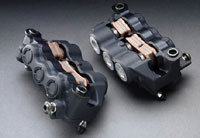 Radially mounted six piston caliper front brakes offer phenomenal stopping performance Yamaha’s engineers have focused a large proportion of their attention on intake air volume in order to achieve increased performance. To maximise the benefits of the YCC-I and YCC-T – as well as the new high-compression 4-valve head design – the R1’s front cowl has been completely redesigned.
The layered structure of the new cowl has been specifically designed to reduce air resistance and increase the flow of intake air, and in doing so it helps to increase the intake air volume – a key factor in achieving the increased performance of the new R1 engine.
The cowl’s layered structure increases the speed of the air flow over the bodywork, and this creates a negative pressure in the mass of hot air surrounding the engine. This negative pressure effect causes the hot air to be drawn away from the engine, thus ensuring that the new R1 delivers consistently high levels of performance during sustained high rpm use.
Since the launch of the first R1, this iconic machine’s athletic and aggressive bodywork has always set the standard for style, functionality and presence and the 2007 model continues this tradition. Finely-defined edges convey a truly dynamic feel, and the wide air intake has been deliberately designed with a look that accentuates its actual function of drawing in greater volumes of air to boost engine performance – while the new 2-eye 4-bulb headlights give the bike an unmistakeable R-series face.
At the rear there is a compact new tail assembly and newly designed seat, as well as a new LED tail light and separate mudguard with license plate holder – and the double underseat mufflers form a ‘V’ configuration for a distinctive looking rear end.
Air intake design is both functional and aesthetic, ensuring combustion efficiency is maximised and R1 family look retained.
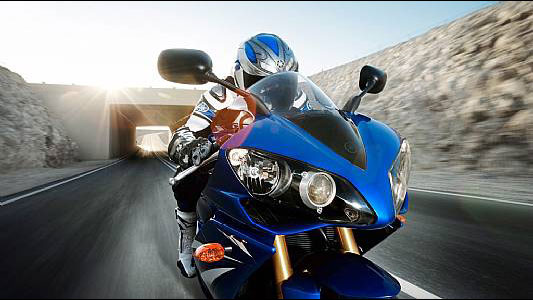
The other notable features on the new R1 include a newly designed front-rear two-part ‘covered top’ fuel tank as well as new instrumentation with a needle type tachometer and digital speedometer. And to handle the increased performance a new twin fan radiator is fitted.
Chassis Technical Highlights
• All-new Deltabox frame
• Redesigned hybrid asymmetric swingarm
• 3mm higher swingarm pivot axis
• New-design high-performance front forks
• Higher specification rear shock with 2-way compression adjuster
• High-rigidity lower triple clamp
• High performance 6-pot front brake calipers
• Lightweight 310mm diameter front discs
• All new front cowl, seat and tail cowl
• Increased air intake capacity
• More efficient dissipation of heated air from engine
• 4-bulb dual headlights
• LED taillight
• New rear fender with separate licence plate holder